7 Core Developing Exercises

Developing core strength is essential for everyday health and well-being, as a strong core protects the spine, reduces back pain, enhances movement patterns, and improves balance, stability and posture.

There are many methods for developing core strength, as well as various pieces of equipment that assist in that development. However, there are plenty of exercises that require only body weight or basic equipment. The most important thing to remember when training the core is to avoid using momentum and instead perform each exercise with awareness so that the core is actually braced or engaged.

The following seven core stability exercises can be added to your current workout routine. If some of these exercises feel too challenging, try the regressed version given in italics. If the featured equipment is not available, use your own body weight. 

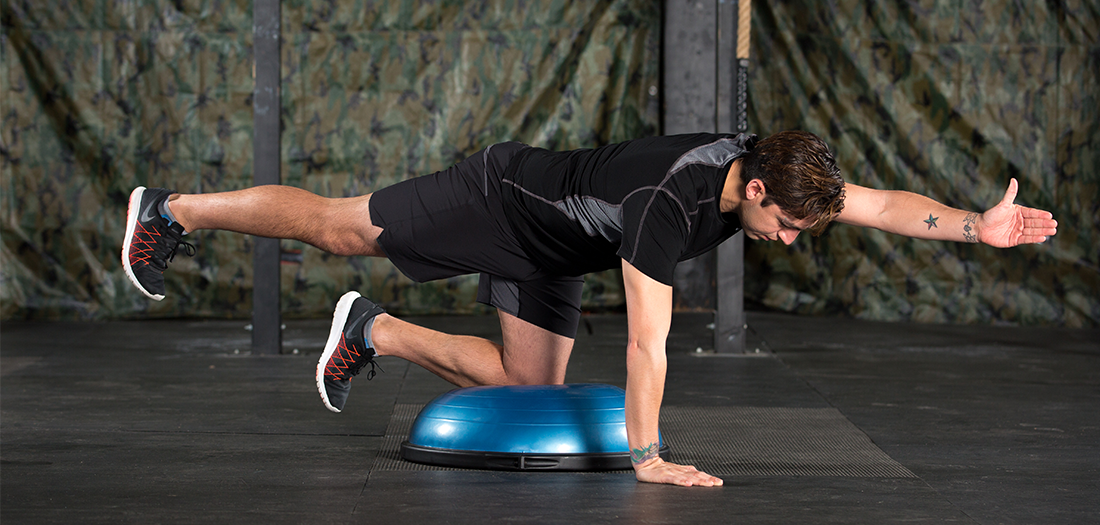
BOSU Bird Dog
bosu-bird-dog

Focus: Core stability
How to Perform: Set your right knee on the center of the dome and place both hands on the floor underneath the shoulders. Extend the left leg behind you to hip height; keep the foot flexed. Raise the right arm to shoulder height with your thumb facing the ceiling. Hold for 20 seconds and switch sides.
Regression: Perform the exercise on the floor.

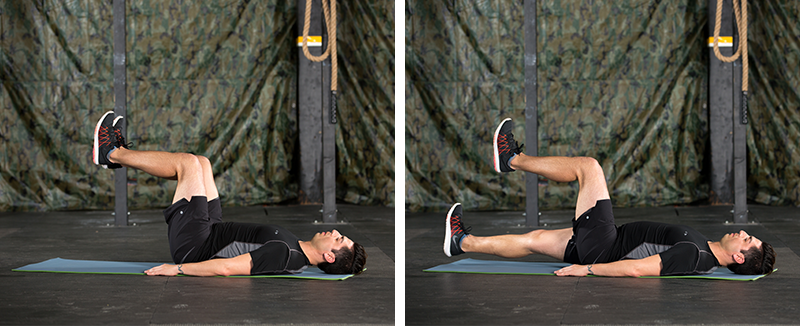
Supine Toe Taps
supine-toe-taps

Focus: Core stability
How to Perform: Lie on your back and place your arms by your sides. Engage the abdominals and draw the navel toward your spine. Lift the knees to 90 degrees. On a two-count, lower your right foot to touch the floor, and on a two-count, return it back to 90 degrees. Perform the same movement with your left leg and continue to alternate tapping the right and then the left foot onto the floor. Perform 10 reps on each leg.
Regression: Keep your feet on the floor, and slide your heel on the mat, alternating legs.

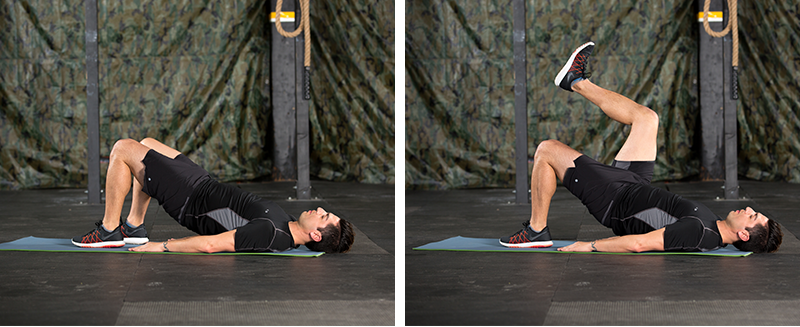
Marching Hip Bridge
marching-hip-bridge

Focus: Lumbo-pelvic stability
How to Perform: Lie on your back and place your hands by your sides. Lift the hips and hold a hip bridge. Lift the right foot off the floor to 90 degrees at the hip and knee. Return the foot onto the floor and then lift the left foot to 90 degrees; return to center. Keep the hips lifted and maintain a neutral pelvis as you alternate leg lifts for 20 repetitions.
Regression: Hold a static hip bridge, keeping both feet on the floor for 30 or more seconds.

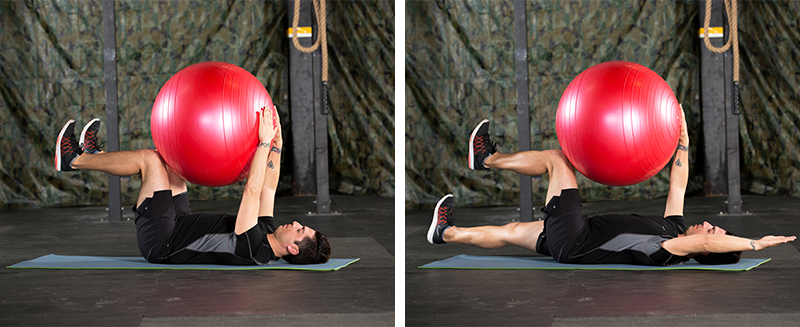
Stability Ball Deadbugs
stability-ball-deadbugs

Focus: Core stability
How to Perform: Lie on your back and lift your knees to 90 degrees. Place a stability ball between your lower legs (near the knees) and press your hands and legs into the stability ball. Engage the core and draw the navel toward the spine. Extend the arms and legs—the straighter the limbs, the more challenging the pose. Make sure the knees stay at 90-degrees when returning back to center (the calves touching the hamstrings makes the exercise easier). Complete 10 reps on each side.
Regression: Perform the exercise without a stability ball, and keep your knees at 90 degrees as you lower. It’s similar to toe taps, but with the addition of the arms.

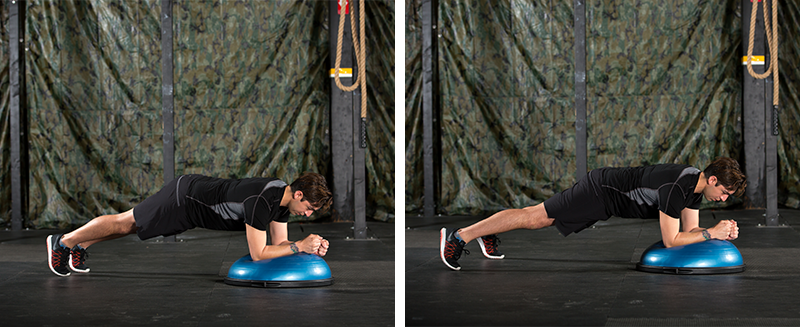
Forearm Plank With Toe Taps
forearm-plank-toe-taps

Focus: Core stability and hip strength
How to Perform: Position the body into a forearm plank with the feet touching. Begin alternating lateral toe taps, where the right foot pushes away from the body, touches the floor and then returns to center. Repeat with the left leg. Complete a set of 10 reps on each leg. Use a BOSU to make the exercise more challenging.
Regression: Perform a static forearm plank with feet hip-distance apart.

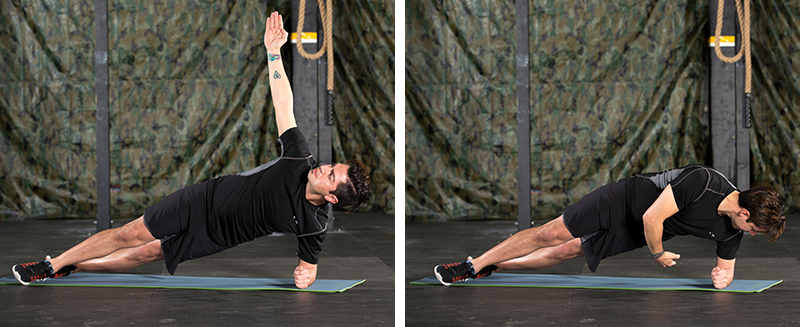
Side Plank With Torso Rotation
side-plank-rotations

Focus: Core strength and shoulder stability
How to Perform: Position the body into a forearm side plank. Both legs should be extended. Lift the top arm over the chest and then rotate with your rib cage to draw the hand underneath the ribs. Repeat this motion for 10 to 12 repetitions and then perform on the other side.
Regression: Perform the exercise in modified side plank with your bottom shin on the floor.

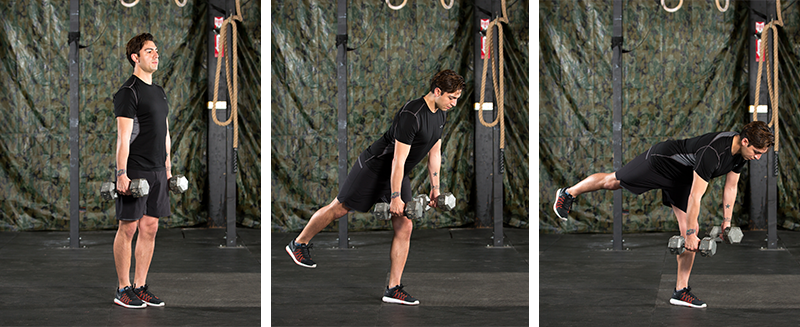
Single-Legged Deadlift
single-legged-deadlift

Focus: Posterior strength
How to Perform: Hold a set a dumbbells and stand tall with feet hip-distance apart. Lift the right foot off the floor; hinge the pelvis to glide over the top of the left leg. The head and the foot should counterbalance each other. The lowest hinging point should be when the body is parallel to the floor. Keep the pelvis as neutral as possible. Complete 12 repetitions on each leg.
Regression: Perform the exercise without dumbbells or complete a deadlift with both feet on the floor.
Physical Activity vs. Exercise: What’s the Difference?

How did you spend your last 24 hours? What do you do during a typical 24-hour weekday? Take a few moments and divide up those 24 hours and reflect on how you typically spend that time. How many hours did you spend sleeping? How many hours did you spend sitting down (don’t forget the times you sit in the car, while you eat, etc.)? How many hours did you spend moving? 

Once you have completed your 24-hour self-reflection activity, think more specifically about your movement time. What type of movement did you do? What was the intensity and intentionality of that movement? 

Over the past few decades, Americans have heard over and over that a minimum of 30 minutes of daily exercise is essential to good health. However, the latest research suggests that how much time we spend sitting could be just as important as how much time we spend exercising. In fact, a new term has been coined to describe those who exercise, but spend the majority of their days being sedentary: active couch potatoes. 

While the term couch potato usually refers to a lazy person who prefers to just sit around and watch TV, an active couch potato refers to someone who is inactive for the majority of the day, but regularly makes sure to get in 30 minutes of exercise on most days. An active couch potato is not necessarily lazy, but spend most of his or her time sitting during leisure time, work (and commuting to and from work) and while eating meals. In other words, they’re almost completely physically inactive throughout the day, with the exception of that 30 or minutes of daily exercise. Although 30 minutes of exercise is absolutely beneficial and healthful, the rest of the day is causing tremendous health hazards. In fact, the World Health Organization (WHO) has identified physical inactivity as an independent risk factor for chronic disease development, and it is now the fourth leading cause of death worldwide. 

So, exactly how do we differentiate between exercise and being physically active? And is the distinction important? Here are some definitions that should help clear things up: 

Physical activity is movement that is carried out by the skeletal muscles that requires energy. In other words, any movement one does is actually physical activity. 

Exercise, however, is planned, structured, repetitive and intentional movement intended to improve or maintain physical fitness. Exercise is a subcategory of physical activity. 

Research provides significant evidence that ALL physical activity positively contributes to overall health and well-being. Exercise also assists with the improvement of physical fitness, which consists of five specific components: 

-Cardiorespiratory fitness

-Muscular strength fitness

-Muscular endurance fitness

-Flexibility fitness

-Body composition 

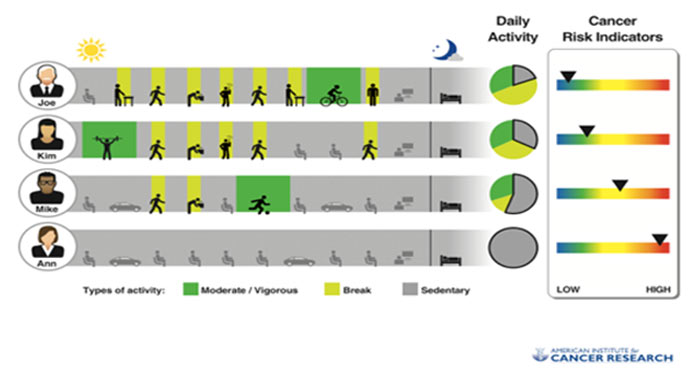
This graphic from the American Institute for Cancer Research visually depicts the importance of both daily physical activity AND structured exercise (in relation to cancer indicators). Here, the green reflects structured exercise, while the yellow reflects daily physical activity. 

Source: American Institute for Cancer Research 

How Can You Become More Physically Active?

An easy way to start transforming a sedentary lifestyle into a more active one is to begin standing more and sitting less. If you work at a desk all day, create a workstation that requires you to stand (and therefore move more). Think about creating opportunities to walk at lunchtime and before or after work. Consider adding leisure time activities to your weekly routines, especially those that involve the whole family, such as bike rides, hikes and walks around the neighborhood. What about your home? Do you enjoy gardening? Make time for it throughout the week instead of leaving it all to the weekend. And instead of dedicating just one day every other week to clean, try to include daily active chores that take 10 minutes or less. When you engage with technology, creatively think about how you can move. Try placing some simple equipment like a yoga mat or resistance ball or resistance bands in your living room so they are easily accessible while watching TV. There are countless opportunities to increase daily physical activity, but you do have to look for them. 

As you evaluate your 24-hour activity reflection, consider making a detailed plan that includes both elements: 

1. Daily increased physical activity

2. Structured, planned, intentional exercise to improve physical fitness 

Omitting one or the other can have serious and detrimental consequences for your health, fitness and overall well-being. Don’t be a couch potato or an active couch potato—make the change today and add BOTH elements to your life to reap the life-changing benefits of physical activity and exercise. 

Fitness Terminology | 10 Popular Fitness Terms Defined

Woman working out

Fitness Terminology: 10 Popular Fitness Terms Defined

Every subculture has its own terminology for describing its way of life. The health and fitness subculture is no different. A few years ago, complaining about the HIIT in your WOD at your local box would have only made sense to extreme fitness enthusiasts. Thanks to the explosive popularity of CrossFit and other high-intensity training programs, we now know that HIIT refers to high-intensity interval training and WOD is an acronym for the unique Workout of the Day offered at CrossFit training facilities (commonly called a ‘box’). 

Whether you’re new to the fitness scene or have been working out in health clubs for years, you’ve probably heard certain fitness terminology thrown around. Here are 10 commonly used fitness terms along with a brief explanation of the science behind each one.

Burning 

When it comes to exercise, burning is often used to refer to the feeling of when muscles experience an accumulation of metabolic waste, which creates fatigue. Acidosis is a change in blood acidity—specifically, elevated levels of lactic acid and hydrogen ions—that is often the result of moderate- to high-intensity exercise. A burning sensation in a muscle is an indication of acidosis. It’s also a sign that it is time for a recovery period to allow the body to remove metabolic waste from the working muscles and replenish the nutrients required to continue performing muscle contractions. 

Cardio 

Cardio is short for cardiorespiratory or cardiovascular exercise and refers to exercise that elevates the heart rate to pump oxygen and nutrient-carrying blood to the working muscles. Most often used for exercise performed on equipment like treadmills, elliptical runners or stationary bikes, it is important to know that ANY exercise that elevates the heart rate can provide cardiorespiratory benefits. Circuit training with free-weights or performing an AMRAP (as many rounds of a particular circuit as possible in a given amount of time) can be considered cardiorespiratory exercise. 

Core Training  

This has become one of the most popular and overused fitness terms of the past several years. It seems as if almost any fitness class, workout program or equipment will provide “core training” benefits. The “core” most often refers to the muscles that make up the mid-section of the body, including the ever-elusive six-pack. However, it is much more effective to think of the body’s core as the center of gravity and not an actual group of muscles. When we look at how the body functions during upright movement patterns such as walking, lifting an object off of the ground or moving an object from one place to another, we have to consider the fact that any muscle that attaches to the spine, rib cage or pelvis influences movement around the body’s center of gravity. 

High-intensity Interval Training (HIIT)

We have written previous blogs about the benefits of HIIT here and here. This term makes the list because it is often used to refer to exercise performed at maximal intensity. However, it’s important to remember that intensity can be subjective—what may be low intensity for some may be high intensity for others.

For individuals with a history of being sedentary or who have been dealing with chronic medical conditions that limit their ability to exercise, simply walking continuously for a few minutes at a time could be considered “high intensity.” 

Metabolic Conditioning 

Similar to HIIT, metabolic conditioning is often used to refer to high-intensity exercise performed to the point of being out of breath or experiencing muscle soreness. Here is why this overused term ought to be retired from the lexicon: Metabolism is the chemical process by which a biological organism produces energy for muscular contraction. That means that any exercise requiring a muscle contraction (which in itself requires energy) is a form of metabolic conditioning. Standing from your chair after reading this post requires your metabolism to fuel your muscles. Therefore, it is more appropriate to describe the level of effort required to perform the planned activity, such as low-intensity, moderate-intensity, high-intensity or maximal intensity. 

Mind-body 

This term is commonly used to describe a general mode of exercise such as yoga or Pilates, because they are traditionally performed with bodyweight (with the exception of Pilates programs involving equipment such as a reformer or barrel) and require concentration to execute challenging movement sequences. However, any purposeful movement, whether it’s a biceps curl or downward facing dog, requires conscious effort. Therefore, almost any physical activity that involves learning and executing movement patterns, no matter how basic, requires cognitive focus and should technically be classified as mind-body.   

Muscle Confusion 

A popular consumer-oriented fitness program claims to be based on the science of “muscle confusion.” This is simply a marketing term created to describe the physiological effect of periodization, which is a method of organizing exercise programs based on alternating periods of intensity. The concept of periodization was developed by Soviet Union sport scientists who recognized that periods of high-intensity exercise (high stress) should be followed by a period of low-intensity exercise (low stress) to let the body to fully recover from the workouts and allow the time for the physiological adaptations to occur. 

Plyometrics 

Many programs or fitness classes refer to using plyos, which is short for plyometrics. Looking at the etiology of the word, ‘plyo’ (from pleio) is a pre-fix for “more” and metric refers to length; therefore, plyometric means “more length.” This describes the physiological affect of the involved muscles during jump training (the most common application for the lower body) or explosive movements such as medicine ball throws (often used for upper-body plyometric training).  

Plyometric training was developed by Soviet sport scientists who originally referred to it as “shock training” because of the high forces experienced by the involved tissue. That’s why it’s important to perform only a few repetitions at a time to achieve the highest level of force output possible. Any program requiring participants to perform more than five or six rapid movements (i.e., jumps or explosive lifts) in a row can significantly increase the risk of injury by placing too much force on the involved tissue. 

Tabata  

A number of exercise programs and classes are called Tabata, which is an actual person. Twenty years ago, Dr. Izumi Tabata, an exercise scientist from Japan, and his colleagues conducted research on ways to improve aerobic capacity using short intervals of extremely high-intensity exercise. They found that exercising at 170% of aerobic capacity on cycle ergometers for a work interval of 20 seconds followed by a brief recovery interval of only 10 seconds, repeated to exhaustion, was extremely effective at boosting aerobic capacity. Since publishing the study in 1997, Dr. Tabata’s name has been used to refer to a protocol of high-intensity interval training featuring 20-second work intervals followed by 10-second recovery intervals for eight cycles (a total of four minutes).  

Toning 

If you ask most people what their general fitness goals, the answer often is to “tone up and get in shape.” We have come to accept the term “tone” to mean muscular definition, or the appearance of a well-defined muscle. The term is actually short for tonus, which is the technical term used to describe a state of contraction in a normally functioning muscle. Using a muscle repeatedly during a strength training exercise will leave that muscle in a state of semi-contraction, creating the defined appearance we have come to expect as the result of exercise.

How to Eat & Workout for an Ectomorph Body Type

Do you look more like a marathon runner than a swimmer? Would you describe yourself as long and lean, willowy or wiry? Is it difficult for you to put on muscle mass? If you said, “yes” to any of these questions, then you most likely have an ectomorph body type.

Physical Characteristics

Models who grace the covers and pages of most fashion magazine tend to have an ectomorph body type. In addition to being tall, they have a thin build, long limbs, small joints and thin bones. Many are flat chested and don’t have much junk in the trunk. Although they appear skinny, they can actually have higher body fat than one might expect. Ectomorphs have a difficult time putting on muscle mass because their metabolism has a tendency to run higher than other body types. In the fitness world, we would refer to them as “hard gainers.” Famous female ectomorphs include Kate Moss, Natalie Portman, Taylor Swift, Kate Middleton and Cameron Diaz. Famous male ectomorphs include Matthew McConaughey, Bradley Cooper and Toby McGuire.

Diet and Metabolism

Ectomorphs have a fast metabolism, which is both a blessing and a curse. A high metabolism makes is easy to get lean, and it can seem as if they can eat whatever they want and not gain weight. However, with age, their metabolisms will slow down, primarily due to low muscle mass, which can result in an unhealthy gain in body fat.

The best diet for an ectomorph is one that is higher in carbohydrates and calories. Approximately 50 to 60 percent of calories should come from carbs, 25 percent from protein and 25 percent from fat.

Additional Nutrition Tips

  • Eat every two to four hours.
  • Add at least 500 calories if you want to gain weight or muscle.
  • Choose warm foods over cold foods (better for digestion).
  • Best starchy carbohydrates include oats, brown rice, quinoa, sweet potatoes and potatoes.
  • Best fruit choices include bananas, mangoes, pineapple, papaya, avocado and peaches.
  • Best vegetable choices include broccoli, cauliflower, brussel sprouts, beets and carrots, especially cooked in coconut oil or ghee (clarified butter).
  • Nutrient dense snacks include nuts and seeds, as well as nut butters. 

The key is to still eat a healthy, balanced diet rich in nutrients. Just because you have an ectomorph body type, doesn’t mean you should use that as an excuse to eat everything, including junk food.

Pre- and Post-workout Nutrition

About 30 to 60 minutes before a workout, make sure to eat or drink a fast-digesting carbohydrate and some protein, such as fruit or toast with almond butter and jam. These nutrients will help keep you energized throughout your workout. And don’t forget to stay hydrated before and during your workout. If your exercise lasts less than 60 minutes, hydrate with water. If it’s longer than 60 minutes, consider adding a fast-digesting carb (gel, blocks, or beverage) to keep your energy level up.

Your post-workout meal should be consumed 30 to 60 minutes after your workout. The ideal post-workout meal includes a 3:1 or 4:1 ratio of carbs to protein to help quickly replenish your glycogen stores and repair and build muscle fibers. Here’s an example of a great post-workout meal from our breakfast cookbook, No Excuses! 50 Healthy Ways to ROCK Breakfast!

Nutty and Fruity Amaranth Hot Cereal

(Makes 1 serving)

  • 1/3 cup amaranth
  • 2/3 cup water
  • 1/4 cup rice milk
  • 1/4 cup dried cranberries
  • 1 Tbsp. chopped nuts
  • 1 Tbsp. chia seeds
  1. Bring water to a boil in a pot and add the amaranth. Cover and reduce heat to a simmer and cook until the water is absorbed. Stir in the rice milk, cranberries, nuts and chia seeds. Pour into a bowl and serve. 

Fitness Goals

Ectomorphs are at a disadvantage when it comes to building muscle and sculpting the body. The goal of toning, sculpting and creating curves on a small, thin frame can be achieved with a dedicated training and nutrition program. All ectomorphs, whether his or her goal is to be a body builder or achieve a healthy, lean and strong body, can benefit from a solid, consistent weight-training program.

Cardio

Ectomorphs tend to excel in endurance-type activities, so it’s not surprising that many prefer cardio training over weight lifting. The key to stimulate muscle growth is to do the minimal amount of cardio required for general health. Three times a week for 30 minutes is recommended.

Weight Training

To build muscle mass, increase strength and sculpt the body, a simple weight-training routine using heavy weights is critical for the ectomorph. The focus should be on using heavier weights and completing three to five sets of approximately eight to 12 reps for each muscle group.

Weight Training Weekly Workout for Ectomorph: Heavy weight, pyramid rep scheme

Day 1 – Chest/Triceps

Incline dumbbell press, 12, 10, 10, 8

Dumbbell flyes flat bench 3 x 12

Overhead extensions 12, 10, 10, 8

Dips 3 x 12

Day 2 – Back/Biceps

Wide-grip pull-ups 12, 10, 10, 8

Bent-over dumbbell rows 12, 10, 10, 8

Seated barbell curls 12, 10, 10, 8

Alternate dumbbell curls 3 x 12

Day 3 – Legs/Shoulders

Leg press 12, 10, 10, 8

Lying leg curls 12, 10, 10, 8

Barbell squats 3 x 12

Deadlifts 3 x 12

Walking lunges 3 x 12 each leg (total 24)

Military press 12, 10, 10, 8

Rear delt flyes 3 x 12

Lateral raise 3 x 12 

Day 4 Rest/Slow Steady-state Cardio

Day 5 – Total-body Superset

Push-ups 3 x 12 with close grip lat. pulldown 3 x 12

Skull crushers 3 x 12 with standing biceps curls 3 x 12

Arnolds (shoulder press) 3 x 12 with step-ups 3 x 12 each leg

Days 6 and 7 Rest/Slow Steady-state Cardio

5 Simple Bodyweight Exercises That Make A Complete Workout

Once you’ve convinced yourself to dedicate some part of your day to working out, you’re bound to be faced with a bigger dilemma. Where do you start? There’s a world of options out there from cardiovascular training and strength training to weight lifting and pilates. But, you don’t have to feel overwhelmed. If you’d like to start small and still get in a good workout, we have a few simple exercises that will give you a complete workout.

1. Plank

Plank exercises are good for the core muscles.

You don’t need to do situps and crunches to get the perfect abs. Doing planks is a much better alternative. Plank is also a better option for your back as other core exercises like crunches, situps, and leg lifts strain your back.

What Muscles It Works On

It works for your glutes and hamstrings. It engages a more diverse set of core muscles (front, back, and sides) when compared to other core exercises. It also works on all the muscles at the same time instead of one in isolation. This is important for sports and recreational activities since they engage all your core muscles at the same time as well.

2. Squats

Squats build strength in the legs and hips.

Squats are one of the most functional exercise routines. They help build strength in your legs and your hips. However, while they might look simple, they need to be done with proper form. When done incorrectly, squats can cause knee pain.

What Muscles It Works On

Squats work excellent for your leg muscles. It also tones your abs, hip and thigh muscles.

3. Push-Ups

Push ups work on your arms, shoulders, chest, core, and legs

Push-ups feature in almost every workout there is. This isn’t just because they can be done anywhere and don’t require weights. Like squats and planks, push-ups need a good form as well.

What Muscles It Works On

Push-ups work your chest, legs, shoulders, hips, arms, and core. They can also be modified according to your needs just by changing the position of your arms. When your hands are placed a little inward, they work on your chest muscles and when you place them a little outward, they work on your

If a traditional push-up is too difficult for you, then you could place your knees on the floor as well. Repeat this as often as you can, and break your repetitions into sets. Challenge yourself by setting goals and make this exercise more fun.

4. Dips

Dips work on your triceps, back, upper arms, and shoulders

Dips are a part of most bodyweight workout routines. They’re also easy to do and don’t require any equipment. As with any exercise, it’s important to stay in good form when you’re doing dips as well.

What Muscles It Works On

They work on your triceps, back, upper arms, and shoulders and eliminate stubborn fat from the triceps.

You could repeat this exercise 10–12 times for optimum results. Slowly build your way up the repetitions.

5. Pull-Ups

Pull-ups

Pull-ups are difficult to do but extremely effective. You could do a pull up in the gym, on monkey bars, or in your home with a pull-up bar.

What Muscles It Works On

They work on the upper back, core, and arms.

If there’s a pool around your place, you could also try a pull-up with the end of a diving board. Repeat 12 times or as many times as you can. As with most other exercises, pull-ups have variations that you could gradually incorporate into your exercise regime.

It’s important to remember that you need to warm up before your workout and cool down after you finish your routine.Your body might also get used to the same kind of exercises very soon, so be sure to switch things up if these exercises aren’t challenging you enough.

References[+]

:)
Design a site like this with WordPress.com
Get started